The group chat says “poker at eight.” One friend means eight. Another means after dinner. A third has exactly an hour. Before you choose the blinds, choose a game that fits the people turning up.
Cash tables and Sit & Go (SNG) tournaments both give you Hold’em with your friends. They ask for different kinds of commitment, though. A cash table can accommodate a changing guest list. A tournament gives a settled group something to finish together.
The quick choice: pick a Sit & Go when everyone can start together and wants to play for a finishing place. Pick cash when people need flexibility. On pokr, both use virtual chips only. “Cash” is the format name; there are no real-money deposits, withdrawals or wagering.
Two formats, two kinds of evening
At a cash table, the blinds stay fixed and players can join or leave during the session. A tournament starts players with a set stack, raises the blinds as it progresses and eliminates players who run out of chips. These are the basic distinctions in PokerStars Learn’s guide to the two formats; registration and re-entry rules vary between tournaments. Here is how the choice works for a private game on pokr.
| Your evening | Cash table | Sit & Go on pokr |
|---|---|---|
| Friends arrive at different times | Join as seats become available. | Get everyone seated before starting; registration closes at the start. |
| Someone has to leave early | The remaining stack returns to their club balance. | Leaving after the start does not return the remaining stack as a cash-table exit would. |
| Everyone wants a winner | Agree how you want to wrap up the evening. | Play towards a final result and tournament placings. |
| Someone loses their stack | They can buy in again within the table limits if their club balance allows. | They are out of that tournament; no re-entry after the start. |
| The group wants fixed blinds | The blinds do not climb. | The blinds rise as hands are completed. |
Choose cash for an open-door evening
Imagine four friends playing while two more finish dinner. Nobody knows exactly when they will arrive. Cash is the easier fit: the first group can play, the late arrivals can take available seats, and an early departure does not need to become a discussion about abandoning a tournament.
It also suits a night where the conversation matters as much as the cards. A lost stack need not end someone’s participation. Agree beforehand how you will handle extra virtual chips, so everyone understands the same rules.
Give the evening an ending even if the table has none. “Last hand at ten” is more useful than “we’ll see.” It lets a friend with an early morning join without wondering whether leaving will spoil the night. Finish the hand you are in before leaving where possible; our guide to chips and departures covers the details.
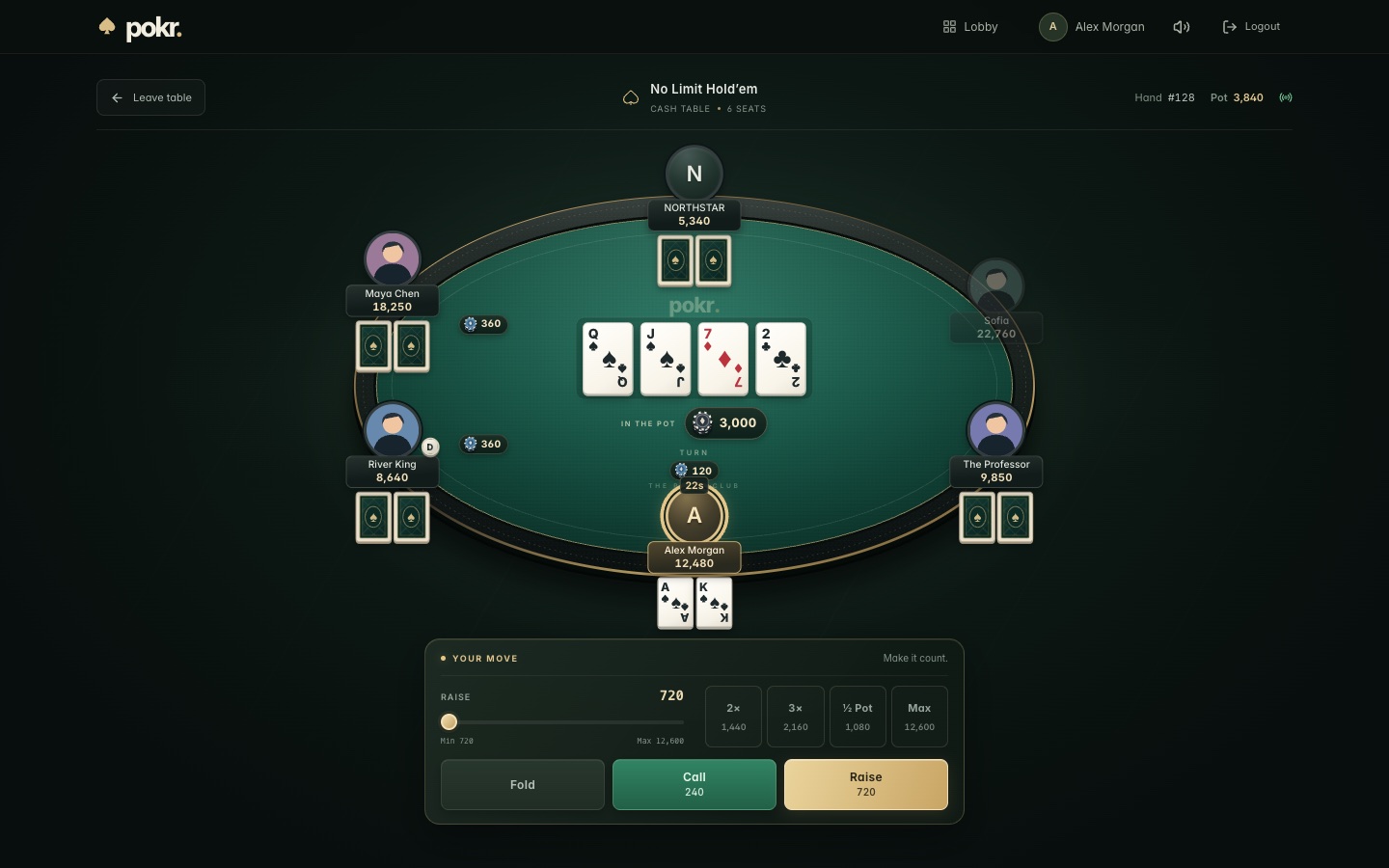
Choose a Sit & Go for a shared contest
Now imagine a different group: everyone is ready, nobody has to disappear halfway through, and someone has already asked who is winning tonight. A Sit & Go gives that evening a clear shape. Everyone begins with the same starting stack, and the field gets smaller as players are eliminated.
The appeal is the finish: the last few players, the bigger decisions, the result you can talk about afterwards. The trade-off is that someone will finish before the others. Make sure the first person out is comfortable watching or doing something else while the game continues.
On pokr, a club owner or manager starts the tournament manually once at least two active players are seated. You do not have to fill every seat. You do need to wait for anyone who wants to participate: a friend arriving after the start cannot join that tournament.
A tournament is not a timer
A Sit & Go has a finish, but that does not give it a guaranteed finishing time. If someone must leave at nine, “we should be done by then” is a poor basis for choosing the format.
In pokr’s default Sit & Go structure, blinds rise after every eight hands until the final level. They start at 10/20, then move to 20/40 and 50/100. The clock is not what advances them. The number of players and the time taken over decisions affect how long the evening lasts.
A starting stack of 1,500 chips is 75 big blinds at 10/20. An unchanged 1,500-chip stack would be only 15 big blinds at 50/100. That change is part of the tournament experience: the same number of chips buys less room as the blinds rise.
Which format is friendlier to beginners?
For a group still learning when to check, call or fold, a cash table using virtual chips is an easier starting point. Fixed blinds remove one moving part, and losing a stack does not have to mean sitting out the rest of the evening. Explain the buttons before starting and keep the first session simple.
A tournament can still be a good first experience if everyone likes the idea of elimination and a final winner. Explain that part clearly. “You might be out while we keep playing” matters more to a newcomer than a detailed explanation of payout percentages.
Whichever format you choose, let new players make their own decisions. Save hand discussions until the hand is over. If you need the practical steps for creating a club and inviting people, use the home poker night setup guide.
Send three questions to the group
- Can everyone be seated at the same time? If the answers are vague, cash makes the evening easier to start.
- Does anyone have a firm leaving time? Plan around that person before committing to a tournament.
- Do we want everyone playing for most of the evening, or do we want tournament placings? This is often the deciding question.
You can try both over two evenings. Start with a relaxed cash session, then arrange a Sit & Go for a night when the whole group is available. After each game, ask what people enjoyed and what made it awkward. Their answers will tell you more than a universal ranking of poker formats.
Your friends. Your kind of game.
Create a private club, choose cash or Sit & Go, and share the invite. Play in your browser on a phone or desktop, with virtual chips.
Set up your poker night →